
Saltwater Fishing Apparel: What to Wear on the Water
Last Updated: October 23, 2026
Quick Summary
Saltwater fishing apparel is clothing engineered to manage sun, spray, sweat, and salt on the water, and the difference between good and bad gear shows up in hour eight, not hour one. Build your kit around quick-dry polyester performance shirts with UPF 44+ protection, a hat that stays put, and a packable water-resistant shell for the runs out and back in.
- Polyester performance fabric wicks moisture, resists stains and odor, and dries in minutes rather than hours.
- UPF 44+ fabric blocks roughly 97% of UV radiation that reaches it.
- Long sleeves suit peak sun and offshore days; short sleeves suit humid inshore mornings and heavy casting.
- Offshore, wear a three-layer system: base performance shirt, mid layer, and water-resistant outer shell.
- Rinse gear in cool fresh water after every trip and skip fabric softener, which blocks wicking.
Table of Contents
- Saltwater Fishing Apparel: What Actually Matters
- Performance Fabrics: Quick-Dry Fishing Clothes and Why They Beat Cotton
- UPF Fishing Shirts: What the Numbers Mean Before You Buy
- Saltwater Fishing Hats and Headwear That Stay Put
- Offshore Fishing Clothing: Layering for Wind, Spray, and Sun
- Fit, Sizing, and Layering for Men and Women
- Price, Value, and What You Get at Each Tier
- Caring for Saltwater Fishing Apparel So It Lasts
- Frequently Asked Questions
Saltwater Fishing Apparel: What Actually Matters
Saltwater fishing apparel is clothing engineered to manage sun, spray, sweat, and salt on the water, and the difference between good and bad gear shows up in hour eight, not hour one.
The core tension in saltwater fishing clothing is simple: sun protection wants coverage, and heat wants less of it.
A common mistake is treating saltwater gear like lake gear. Salt is abrasive, dries stiff, and accelerates fabric breakdown if you ignore it.
Performance Fabrics: Quick-Dry Fishing Clothes and Why They Beat Cotton
Quick-dry fishing clothes are built from synthetic knits that move moisture away from your skin and release it fast.
Cotton is the wrong tool here. It holds water against your skin, gets heavy, and takes forever to dry once saturated with salt spray, a comfort problem that becomes a safety problem when the wind picks up.
What to look for in the fabric itself:
- Moisture-wicking technology that pulls sweat off your skin rather than trapping it
- Ultra-tight knit for opacity and better print durability
- Stain, odor, snag, and fade resistance so the shirt survives bait, blood, and sun
The American Chemical Society overview of moisture-wicking textile technology explains the capillary mechanics behind wicking fibers if you want the science.
UPF Fishing Shirts: What the Numbers Mean Before You Buy
UPF fishing shirts carry a rated Ultraviolet Protection Factor, and UPF 44+ means the fabric blocks roughly 97% of UV radiation that reaches it. Check that number before you buy, sun protection is the primary job on open water.
UPF is not the same as SPF. SPF rates sunscreen on skin; UPF rates fabric. Our FDA guidance on sun protection and UV labeling covers how UV protection claims are regulated for products sold here.
Long Sleeve vs. Short Sleeve
Long sleeve wins for peak sun and offshore days; short sleeve wins for humid inshore mornings and heavy casting. Most anglers own both: long sleeves cover forearms and neck without sunscreen reapplication, short sleeves keep airflow higher when the heat index climbs.
Our Men's Long Sleeve Performance Shirt ($35.00) is the pick for full-sun days, and the Men's Short Sleeve Performance Shirt ($30.00) covers the hotter, more active sessions. Both use 4 oz. 100% polyester with UPF 44+ and moisture-wicking construction.

Saltwater Fishing Hats and Headwear That Stay Put
Saltwater fishing hats fail in two ways: they blow off, or they soak through and never dry. But the hat is the single most important piece of sun protection you wear, and on the water it doubles as a visibility and safety tool.
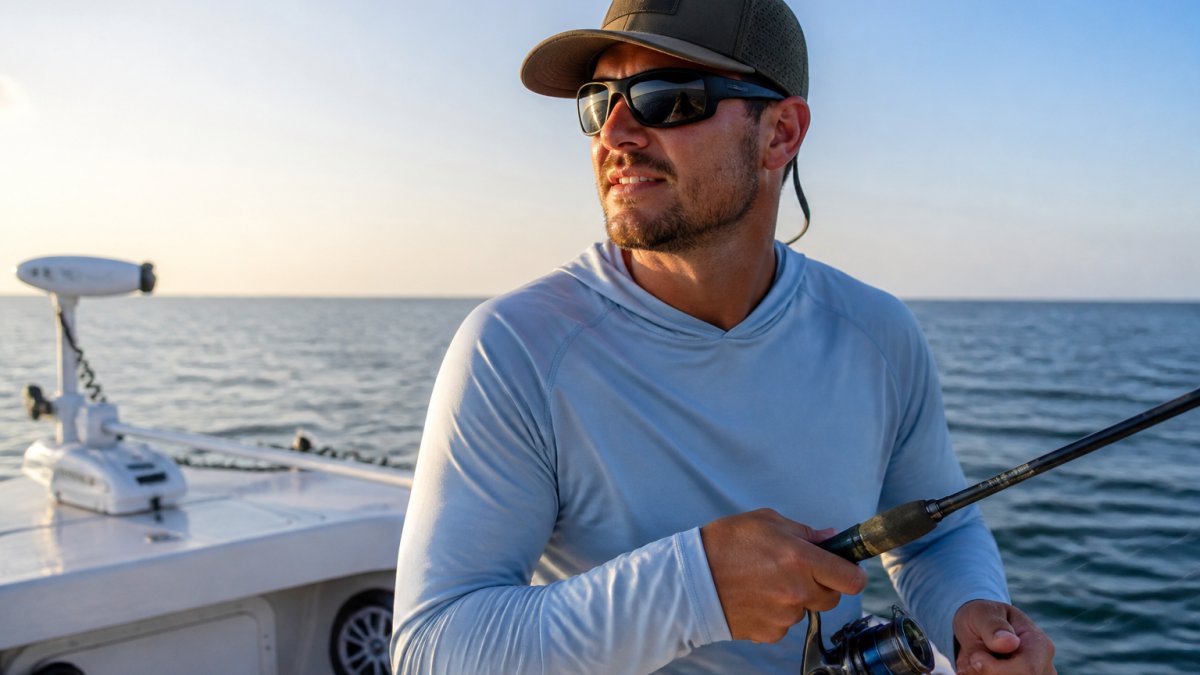
What actually keeps a hat on and working
- Structured front panel: holds shape when wet and keeps the brim off your forehead so air moves.
- Secure closure: a snapback or adjustable strap that cinches below the occipital bone; a hat that fits loose at the back lifts in wind before it blows off.
- Moisture-wicking sweatband: a cotton or foam band soaks and stays soaked; a wicking band dries between drifts.
Brim geometry: match the brim to the fishing
- Wide brim (3 in. or more, full circumference): best for offshore and open-water days where sun comes from every angle. Shades ears and the back of the neck without a separate gaiter. Trade-off: catches wind on the run and can block your view when you cast underhand.
- Mid brim (2.5-3 in., front only): the all-around compromise for inshore and nearshore. Enough shade for eyes and nose, less windage.
- Short brim or visor: best for heavy casting and humid mornings when airflow matters more than coverage. Pair it with a neck gaiter or a collared shirt, because a visor leaves ears and neck exposed.
Offshore, a full-brim hat with a chin cord is the default; inshore, a mid-brim or visor plus a gaiter is often cooler.
Neck, ear, and face protection
A hat alone does not cover the sides of the neck, the ears, or the lower face, the places that burn first on the water. Options, in order of practicality:
- Collar up plus wide brim: the simplest fix, and it works with gear you already own.
- Neck gaiter or sun sleeve: a wicking tube that covers neck and ears under the hat brim. Look for a seamless or flat-locked version so it doesn't chafe on a long day.
- Detachable neck flap: common on full-brim offshore hats; convenient but flaps in wind and can obscure peripheral vision.
Visibility and safety on the water
Headwear is a safety item as much as a sun item. A bright or high-contrast hat makes you easier to spot from the helm, another boat, or a rescue crew. On low-light runs, dawn, dusk, fog, squall lines, high-visibility color or reflective detailing beats style.
Materials and care
Custom patch hats are the coastal standard: the patch holds shape, the embroidery survives washing, and the look reads right on the water and at the dock. Look for a moisture-wicking sweatband and breathable crown. Rinse in fresh water after every trip and air-dry in shade so the brim doesn't warp.
Offshore Fishing Clothing: Layering for Wind, Spray, and Sun
Offshore fishing clothing has to handle wind that cuts through a single layer, spray that soaks your front, and unrelenting sun. The answer isn't one magic jacket, it's a three-layer system built around the two transitions that ruin most anglers' days: the run out and the run back in.
SaltyGrown Men's Short Sleeve Performance Shirt →
The three layers, and what each one actually does
- Base layer, the performance shirt against your skin. Long sleeve for full-sun days, short sleeve for humid, high-output casting. This layer does the wicking and UPF work and should sit close without binding across the shoulders. A hood adds neck and ear coverage, but traps heat on still afternoons, a collar plus wide-brim hat is often cooler.
- Mid layer, a lightweight hoodie or softshell for the runs out and back in. This is your wind layer, not your rain layer. Look for a full-zip front to vent, adjustable cuffs that seal against spray, and a hem that stays down when you lean over the rail.
- Outer shell, a water-resistant or waterproof layer for spray and squalls. Packable beats heavy. A shell is for rain and heavy spray, not all-day wear, worn continuously in the sun it becomes a sauna. Look for taped seams at shoulders and chest, a storm flap over the zipper, and pit zips if you run hot.
How to run the system through a typical offshore day
- Run out (low sun, high wind, spray over the bow): base layer plus mid layer, shell within reach. Wind chill at 30 knots is the real threat here, not heat.
- First drift (sun climbing, boat stopped): strip the mid layer, keep the base layer and hat. Add sunscreen to hands and face; the shirt covers the rest.
- Midday (peak UV, still air): base layer only, sleeves down, collar up, hat on. Vent the shell or stow it. This is when a long-sleeve performance shirt earns its price.
Saltwater-specific trade-offs worth knowing
-
Waterproof vs. water-resistant: a fully waterproof shell keeps spray out but traps sweat; a water-resistant softshell breathes better but wets through in sustained rain.

SaltyGrown Men's Short Sleeve Performance Shirt -
Pockets and closures: zippered chest pockets beat open slash pockets offshore; anything open fills with spray. Look for drainage or mesh pocket bags for phone or keys.
-
Color and visibility: a bright shell or hat on the run out is a safety feature, not a style choice, it makes you easier to spot from the helm and from another boat.
If you buy only one piece beyond the base layer, make it a packable water-resistant shell with sealed shoulders and adjustable cuffs. It covers the two hours, the run out and the run back in, that decide whether the trip is comfortable.
Fit, Sizing, and Layering for Men and Women
Fit is where most online apparel purchases go wrong. Performance shirts should sit close enough to wick but loose enough to cast, paddle, and reach overhead without pulling across the shoulders.
What we tell people before they order:
- Measure your chest and length, not your old T-shirt size, and check the size chart per style
- Size up if you plan to layer a hoodie or shell over the shirt
- Women's cuts are contoured, so a women's performance shirt fits differently than a men's small
Our Women's Tarpon Long Sleeve Performance Shirt ($30.00) uses a contoured women's fit with hemmed bottom and sleeves, UPF 44+, and the same 4 oz. polyester interlock as the men's line.

Price, Value, and What You Get at Each Tier
Price in saltwater fishing apparel tracks three things: fabric weight, sun rating, and construction. A cheap shirt is thinner, with weaker seams and lower UPF; a better one costs more because the knit is tighter, the seams are reinforced, and the print survives the season.
Here's how our line breaks down:
| Style | Price | Fabric | Sun Protection | Best For |
|---|---|---|---|---|
| Men's Short Sleeve Performance Shirt | $30.00 | 4 oz. 100% polyester | 44+ UPF | Hot inshore days, active casting |
| Men's Long Sleeve Performance Shirt | $35.00 | 4 oz. 100% polyester | UPF 44+ | Full-sun offshore days |
| Men's Tarpon Short Sleeve Performance Shirt | $30.00 | 4 oz. 100% polyester | 44+ UPF | Everyday coastal wear |
| Women's Tarpon Long Sleeve Performance Shirt | $30.00 | 4 oz. polyester interlock | UPF 44+ | Sight-fishing, dock days |
What you're paying for over a big-box shirt is construction: reinforced shoulder seams, double needle cover stitch hems, tag-free necks, and fade and snag resistance that keeps the shirt sharp after a full season.
Caring for Saltwater Fishing Apparel So It Lasts
Saltwater fishing apparel lasts longer when you rinse it in fresh water after every trip, because salt left in the fibers stiffens the knit and speeds breakdown.
- Rinse in cool fresh water immediately after the trip, before the salt dries
- Wash cold on a gentle cycle with mild detergent, no fabric softener
- Skip the dryer; hang dry in shade to protect the wicking finish and UPF
Fabric softener is the quiet killer here. The FTC guidance on textile care labeling explains what care labels must disclose, which is useful when you're comparing garments.
That weird discoloration people complain about after a couple months is almost always salt left to dry in the fabric plus sun exposure on an unprotected knit.
Frequently Asked Questions
What should you wear for saltwater fishing?
Start with a moisture-wicking performance shirt rated UPF 40 or higher, long sleeve if you want full arm coverage. Add quick-dry shorts or pants, a hat with a brim, and polarized sunglasses. Avoid cotton, which holds water and dries slowly. For offshore trips, bring a light waterproof shell for spray and wind. SaltyGrown's performance shirts run $30 to $35 and cover the base layer for most inshore and nearshore days.
Are UPF fishing shirts worth it?
Yes, if you fish in open sun for hours. A UPF rating tells you how much UV radiation reaches your skin through the fabric. UPF 44+ blocks roughly 97% of UV rays, which matters on long days when reapplying sunscreen to your shoulders and arms is impractical. The shirts also dry faster than cotton and resist stains and odor, so they hold up across a full season of trips.
How do you care for saltwater fishing apparel after saltwater exposure?
Rinse immediately after use, ideally before the salt dries. Salt crystals work into fabric fibers and can stiffen seams and dull prints over time. Machine wash cold with mild detergent, skip fabric softener, and air dry when possible. Avoid bleach and high heat, which break down moisture-wicking treatments. A quick freshwater rinse at the dock adds years to quick-dry fishing clothes.
What features should you look for in saltwater fishing apparel?
Look for UPF 40 or higher, moisture-wicking fabric, quick-dry construction, and stain and odor resistance. Reinforced shoulder seams matter if you cast repeatedly. Check for tag-free necks and a fit that lets you raise your arms without the hem pulling out. For offshore fishing clothing, add a water-resistant outer layer and a hood or high collar for wind and spray protection.
Salt and sun will find every weak point in your gear eventually. The fix is buying apparel built for the conditions and caring for it like equipment, not laundry. SaltyGrown builds UPF performance fishing shirts, custom patch hats, and coastal apparel for men, women, and kids, with free U.S. shipping on orders of $100 or more and easy returns if the fit isn't right. Shop best sellers and gear up for the next trip.
