
How to Choose Sun Protection for Boating
Table of Contents
- Start With Why UV Exposure Hits Harder on the Water
- Step 1: Pick Sunscreen for Boating That Actually Stays On
- Step 2: Understand the UPF Rating for Clothing Before You Buy
- Step 3: Choose UPF Fishing Shirts Built for Salt and Sweat
- Step 4: Cover Your Head, Face, Neck, and Eyes
- Step 5: Set Up Sun-Protective Clothing for Kids
- Step 6: Build Shade, Reapplication, and Hydration Into the Day
- Your Boating Sun Protection Checklist
- Frequently Asked Questions
Last Updated: October 18, 2026
Start With Why UV Exposure Hits Harder on the Water
Sun protection for boating is not the same as sun protection on land. Water and boat surfaces bounce UV rays back at you from below, so you get hit twice: once from the sky and once off the surface.
A few things make a boat deck a tough place for your skin:
- Reflection: Water, white fiberglass, and light-colored decks throw UV back upward.
- No shade: Most boats offer little cover during peak hours.
- Wind and spray: You feel cooler than you are, so you stay out longer.
- Sweat and salt: Both wear down sunscreen faster than a calm day on land.
That combination means a single application of lotion will not carry you through an eight-hour trip. You need layers: sunscreen, clothing, a hat, and shade. The steps below walk you through each one.
Step 1: Pick Sunscreen for Boating That Actually Stays On
The best sunscreen for boating is a broad-spectrum formula with SPF 30 or higher and a water-resistant label. Broad-spectrum means it blocks both UVA and UVB rays. Water-resistant means it holds up longer when you sweat or get splashed. But the label is only half the job, how and when you apply it decides whether it actually protects you on the water.
A common mistake is grabbing a beach lotion and calling it done. On a boat, you want a few specifics:
- SPF 30 to 50+: Higher SPF gives more margin when you reapply late.
- Water-resistant: Check the label for how long it lasts before you need to reapply, typically 40 or 80 minutes.
- Stick or sport formula for your face: It stays out of your eyes and grips better.
- Lip balm with SPF: Lips burn fast and rarely get lotion.
Apply it correctly before you leave the dock
The American Academy of Dermatology sunscreen guidance recommends applying about 15 minutes before sun exposure so it can settle into your skin. Most practitioners find that adults need about one ounce, roughly a shot glass, to cover the body in a swimsuit, and more if you are covering arms and legs in clothing gaps. Use more than you think you need, and do not forget the tops of your ears, your neck, the backs of your hands, and the tops of your feet.
A practical coverage order helps you avoid missed spots:
- Start with the face, ears, and neck.
- Move to shoulders, arms, and the backs of your hands.
- Cover the torso and legs, then the tops of your feet.
- Finish with SPF lip balm.
Reapply on a schedule, not a feeling
Wind and spray make you feel cool, so it is easy to skip reapplying. That is how most boat-day sunburns happen. Set a phone alarm and reapply on schedule, not when you feel hot.
- Every two hours: Reapply sunscreen to exposed skin, even if you have not been in the water.
- After swimming or heavy spray: Reapply right away, regardless of the water-resistant label.
- After toweling off: Reapply to any area you dried, since toweling removes sunscreen.
- After heavy sweating: Reapply to the face, neck, and arms.
Step 2: Understand the UPF Rating for Clothing Before You Buy
UPF, or Ultraviolet Protection Factor, is the rating system for how much UV fabric blocks. A UPF rating for clothing tells you what fraction of UV rays pass through the material.
Here is how the numbers compare:
| UPF Rating | UV Blocked | Protection Level |
|---|---|---|
| 15-24 | Roughly 93-96% | Good |
| 25-39 | Roughly 96-97% | Very good |
| 40-50+ | Roughly 97-98% | Excellent |
Fabric construction matters as much as the number. Tight weaves block more than loose ones. Dark colors and denser fabrics offer more coverage than thin, light-colored cotton. A basic cotton tee gives you far less protection than a purpose-built performance shirt.

Step 3: Choose UPF Fishing Shirts Built for Salt and Sweat
UPF fishing shirts are the workhorse of any boating sun plan. A long-sleeved shirt covers your arms and shoulders without lotion, and it keeps working all day.
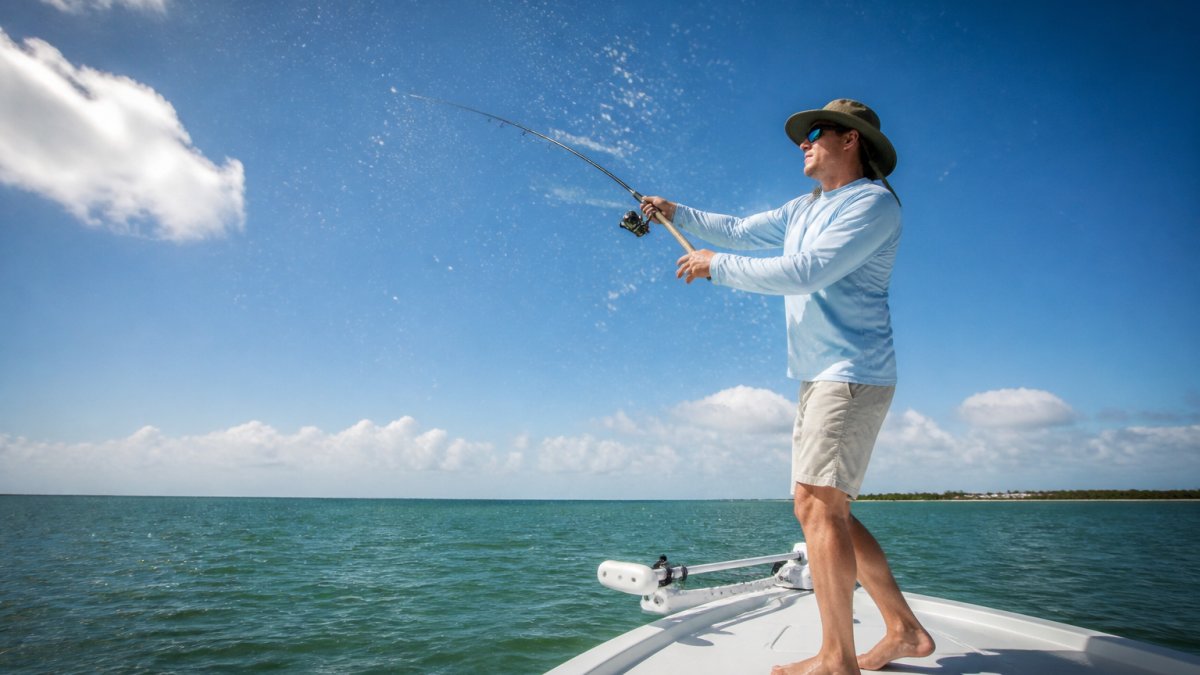
Salt and sweat wreck cheap gear fast. Our SaltyGrown Men's Long Sleeve Performance Shirt uses a 4 oz. polyester knit with UPF 44+ protection, moisture wicking, and snag and stain resistance.
For women, the SaltyGrown Women's Tarpon Long Sleeve Performance Shirt offers the same UPF 44+ coverage in a contoured fit, with fade and snag resistance that holds up season after season.

Step 4: Cover Your Head, Face, Neck, and Eyes
Your head, face, and neck burn faster than anywhere else, because they point straight at the sun. A wide-brimmed hat shades your face, ears, and neck at once.
- Hat: Wide brim for full coverage, or a cap plus neck protection.
- Sunglasses: UV-protective lenses protect your eyes and the skin around them.
- Buff or neck gaiter: Covers the gap a hat leaves behind.
- SPF lip balm: Reapply every couple of hours.
A high-crown cap like our Blue Rope 5 Panel Quick Dry Snapback Cap gives a curved visor and breathable mesh to keep your head cool. It handles the face, but pair it with a neck cover for a full day on open water.
SaltyGrown Men's Long Sleeve Performance Shirt →

Step 5: Set Up Sun-Protective Clothing for Kids
Sun-protective clothing for kids matters most because young skin burns easily and kids rarely sit still for reapplication. Dress them in long sleeves, a hat, and sunglasses, then use sunscreen on the gaps.
A simple routine works best:
- Start with a UPF long-sleeve shirt and swim bottoms.
- Add a wide-brim hat that stays on in wind.
- Apply sunscreen to face, hands, and legs.
- Reapply every couple of hours and after swimming.
- Keep them in shade during the midday peak.
Kids sweat and splash, so pick fabric that dries fast and does not cling. Loose, breathable fits keep them comfortable enough to leave the gear on.
Step 6: Build Shade, Reapplication, and Hydration Into the Day
Shade and timing cut your exposure more than any single product. A bimini top or boat cover gives you a place to retreat during the strongest sun, usually late morning through mid-afternoon. But the right protection plan depends on your boat, your trip, and the conditions, not a one-size-fits-all checklist.
Match your protection to your boat and trip
Use this decision guide to choose what to bring:
- Center console or open boat with no shade: Prioritize wide-brim hats, neck covers, and long-sleeve UPF shirts for everyone. Plan a midday shade break ashore or under a clamped beach umbrella. Bring a spare hat in case wind takes one.
- Boat with a bimini or hardtop: Use the top as your midday retreat, but remember that UV reflects off the water and deck even in shade. Keep sunscreen and lip balm in the shade bag for scheduled reapplication.
- Short trip (under two hours): One application before departure plus a hat and sunglasses may be enough for exposed skin, but bring sunscreen for the ride home.
- Full day or multi-day trip: Pack backup supplies, a second sunscreen, a spare lip balm, and a dry hat, and set recurring phone alarms for reapplication.
- Fishing or sailing with active movement: Choose shirts with ventilation and a fit that lets you cast or trim sails without the fabric riding up. Loose, breathable fits keep gear on when the action starts.
- Hot, humid weather: Light colors and moisture-wicking fabrics help, but do not trade coverage for coolness. A breathable long-sleeve UPF shirt is cooler than bare skin in direct sun.
Read the conditions before you leave
Time of day, cloud cover, and reflection change your protection needs. UV is strongest from late morning through mid-afternoon, and clouds do not block UV the way they block heat, you can burn on an overcast day. Water and white fiberglass reflect UV upward, so shade alone is not full protection. Check the forecast UV index before you leave the dock and treat a high index as a signal to shorten exposed periods and reapply on schedule.
Set a reapplication rhythm and stick to it
- Every two hours: Reapply sunscreen to exposed skin.
- After swimming or heavy spray: Reapply right away.
- Midday: Take a shade break when the sun is highest.
- All day: Drink water. Dehydration makes sunburn hit harder.
Build a backup kit
Keep a small dry bag with a spare sunscreen, SPF lip balm, a spare hat, and a lightweight long-sleeve shirt. Backup supplies matter most on full-day trips, when gear gets wet, lost to wind, or used up faster than expected.
Your Boating Sun Protection Checklist
Use this before every trip so nothing gets left at the dock.
- Broad-spectrum, water-resistant sunscreen, SPF 30+
- SPF lip balm
- Long-sleeve UPF fishing shirt for each person
- Wide-brim hat or cap plus neck cover
- UV-protective sunglasses
- UPF clothing for kids
- Bimini top or shade plan
- Water bottle for each person
- Phone alarm set for reapplication
The Skin Cancer Foundation sun safety tips make the case clearly: layered protection beats any single step. Sunscreen alone will not carry a full day. Clothing, hats, shade, and timing do the heavy lifting.
The right gear makes the routine easy. SaltyGrown builds performance shirts and hats for sun, salt, and open water, so you can stay covered from the first cast to the last.
Frequently Asked Questions
Why should you avoid spray sunscreen on boats?
Spray sunscreen is easy to apply but risky on a boat. Wind carries the mist away before it lands, so you get uneven coverage and waste product. Overspray also settles on gelcoat, vinyl cushions, and teak, where it can leave slippery patches and stains. On a moving deck, spraying near your face means inhaling particles. Lotions and sticks give you a visible, even layer you can control. If you do use a spray, apply it into your hands first, then rub it in, and keep it away from the helm and any nonskid surfaces.
What UPF rating should you look for in boating clothes?
Look for UPF 30 or higher, and treat UPF 50+ as the target for all-day exposure. The UPF rating for clothing measures how much UV radiation passes through the fabric: UPF 30 blocks about 97% of UV rays, while UPF 50 blocks roughly 98%. Fabric construction matters as much as the number. Tight weaves, darker or brighter colors, and looser fits all help. Stretch, wetness, and wear reduce protection over time, so check the label and replace shirts that have thinned out. SaltyGrown performance shirts are rated UPF 44+.
How often should you reapply sunscreen while boating?
Reapply every two hours, and sooner if you are sweating heavily, swimming, or handling wet gear. Apply a full ounce (about a shot glass) to your body 15 to 30 minutes before you leave the dock so it can absorb. Cover the spots people miss: ears, back of the neck, tops of feet, backs of hands, and the part in your hair. Water-resistant formulas hold up better to spray and sweat, but no sunscreen is truly waterproof. Set a phone alarm every two hours so reapplication does not get lost in the fishing.
Does shade on a boat provide enough sun protection?
Shade helps but does not replace sunscreen or clothing. A bimini top or hardtop blocks direct overhead sun, yet UV rays bounce off the water, gelcoat, and metal surfaces, reaching you from the sides and below. Shade also shifts as the boat moves and the sun tracks across the sky. Use shade as one layer: run the bimini, wear a wide-brimmed hat and UPF clothing, and keep sunscreen on exposed skin. On long runs, rotate who sits in the shaded spots so everyone gets a break from direct exposure.
A full day on the water should end with tired arms and good stories, not a sunburn. Build your layers before you leave the dock, and let your gear do the work. Shop SaltyGrown best sellers for UPF performance shirts, custom patch hats, and coastal gear made for long days in the sun.