
Why Performance Fishing Shirts Lose SPF Protection
Table of Contents
- How UV Rays Penetrate Clothing and Degrade Fibers
- The Impact of Moisture and Wetness on UV Protection
- Salt, Detergent Residue, and Chemical Breakdown
- How to Clean Salt from Performance Shirts
- Best Practices for Sun Shirt Maintenance
- Signs Your Fishing Shirt Has Lost Sun Protection
- Extending the Life of Your Performance Fishing Shirts
- Frequently Asked Questions
Last Updated: October 2, 2026
How UV Rays Penetrate Clothing and Degrade Fibers
UV radiation doesn't stop at your skin, it passes through fabric layers, and the damage compounds over time. Understanding this process explains why fishing shirts lose SPF protection, even when you're following care instructions.

UVA and UVB rays penetrate clothing fibers and break chemical bonds within polymer chains, a process called photodegradation that weakens fiber structure from the inside out.
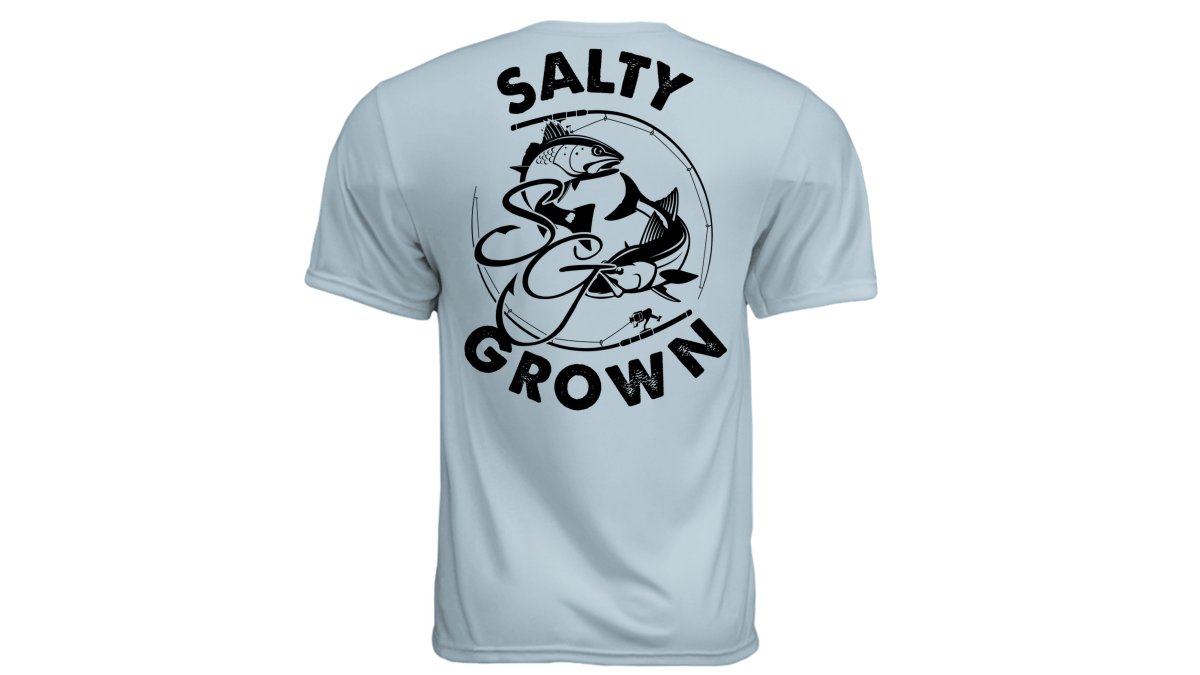
A 4 oz. polyester shirt with tight knit, like the SaltyGrown Men's Short Sleeve Performance Shirt, starts with 44+ UPF protection. But UV protection isn't permanent, every exposure degrades fibers slightly as micro-holes enlarge and polymer chains break down.
Moisture accelerates degradation significantly. When wet, water fills micro-holes and acts as a lens, allowing more UV light to penetrate deeper. Salt water makes it worse, salt crystals left behind create additional pathways for UV rays to reach your skin.
UV damage is cumulative and invisible, your shirt looks fine but protection silently declines with each sun exposure and wash cycle.
The Impact of Moisture and Wetness on UV Protection
Wet fabric loses UV protection faster than dry fabric. When soaked, water molecules fill spaces between fibers and change how light behaves inside the fabric.
Dry polyester has air gaps that scatter UV rays. Water has a higher refractive index, creating a uniform optical path that allows UV light to travel deeper with less scattering, reducing UV blocking by 30 to 50 percent while wet.
For fishing, this matters because your shirt is frequently damp from wading, splashing, or humidity. Over a full season of regular water exposure, the cumulative effect is significant.
Salt water compounds the problem. As it evaporates, salt crystals embed in fibers, creating structural weak points where UV rays penetrate more easily. Repeated salt water exposure leaves thousands of micro-defects throughout the fabric.
A wet shirt may look darker and feel thicker, creating a false impression of better protection. In reality, it provides worse protection while wet.
Salt, Detergent Residue, and Chemical Breakdown
Salt and detergent residue actively degrade the chemical structure of UV-protective treatments and fibers.
Performance fabrics rely on UV-absorbent treatments applied during manufacturing. Salt ions disrupt the chemical bonds holding UV absorbers in place, while detergent residue creates a film that interferes with UV treatment function.
With repeated exposure and inadequate rinsing, you might lose 20 to 30 percent of your original UPF rating after a full season.
How you clean your shirt matters as much as how often. Standard detergent is aggressive; too much or inadequate rinsing leaves residue that breaks down UV-protective chemistry.
Salt presents a different problem. Saltwater exposure leaves behind sodium chloride crystals. These crystals are hygroscopic, they absorb moisture from the air. This constant moisture absorption and release causes mechanical stress on the fibers. The fibers expand and contract slightly with each moisture cycle, causing micro-cracks and weakening the overall fiber structure. Over time, this mechanical wear compounds the UV damage.
How to Clean Salt from Performance Shirts
Removing salt properly is the single most important step in preserving your fishing shirt's SPF protection.
Start by rinsing immediately after exposure. Don't wait until laundry day. Fresh water rinses work best, fill a bucket with cool tap water and submerge your wet shirt. Agitate gently for 30 seconds, then drain.
For heavier salt buildup, use a targeted soak. Fill a bucket with cool water and add your shirt. Let it soak for 15 minutes without agitation. The water dissolves salt crystals gradually. Drain and repeat if needed.
When you're ready to wash, use cold water and a gentle cycle. Choose a mild detergent specifically formulated for performance fabrics, or use half the recommended amount of standard detergent.
The rinse cycle is where most people fail. Run at least two extra rinse cycles after the wash completes. Some modern washing machines have a "extra rinse" setting, use it.
Air dry only. Never use a dryer, heat degrades polyester fibers and accelerates the breakdown of UV treatments. Hang your shirt in indirect sunlight or in shade.
Best Practices for Sun Shirt Maintenance
Extending your fishing shirt's effective lifespan requires a maintenance strategy that addresses salt, moisture, UV exposure, and wear.
First, rotate your shirts. If you fish regularly, own at least two performance shirts and alternate between them.
SaltyGrown Men's Short Sleeve Performance Shirt →
Store your shirts properly. After washing and drying, fold them in a cool, dark place. Humidity and heat accelerate fiber degradation even when the shirt isn't being worn.
Inspect for early signs of degradation regularly. Look for pilling (small balls of fiber forming on the surface), color fading, or changes in fabric texture.
Limit unnecessary sun exposure when the shirt isn't being worn. Don't dry it in direct sunlight or leave it in a hot car.
When you do wear your shirt, reapply sunscreen to exposed areas like your face, neck, and ears. No performance fabric provides 100 percent UV protection, especially as it ages.
Consider the UPF rating as a starting point, not a guarantee. A 44+ UPF shirt blocks approximately 98 percent of UV rays when new. As it ages, that percentage declines.
Signs Your Fishing Shirt Has Lost Sun Protection
Visible wear doesn't always correlate with lost UV protection, but certain signs indicate that your shirt's SPF rating has declined measurably.
Color fading is a reliable indicator. UV rays don't just damage fibers, they break down the dyes that color the fabric.
Pilling, those small balls of fiber that form on the surface, indicates fiber degradation. Pilling happens when UV damage and mechanical wear weaken fibers enough that they break off and ball up.
Loss of fabric stiffness is another sign. New performance fabric has a particular hand, it feels crisp and structured. As fibers degrade, the fabric becomes softer and more limp.
Transparency changes are subtle but telling. Hold your shirt up to a bright light. Compare it to a new shirt of the same color.
Odor persistence after washing is a practical sign. As fibers degrade, they become more porous and absorb odors more readily.
Extending the Life of Your Performance Fishing Shirts
Getting three to four full seasons of reliable sun protection from a performance fishing shirt is realistic with proper care. Getting five or more seasons requires intentional maintenance.
The most impactful practice is immediate freshwater rinsing after salt water exposure. This single step prevents salt crystallization and reduces fiber degradation by an estimated 30 to 40 percent compared to shirts that aren't rinsed immediately.
Second is using the right detergent. Performance fabrics benefit from detergents formulated for synthetic fibers or sports clothing. These are gentler on UV treatments and less likely to leave residue.
Third is minimizing heat exposure. Never use a dryer. Never wash in hot water. Never store in direct sunlight. Heat accelerates the chemical breakdown of both the fibers and the UV-absorbent treatments applied to them.
Fourth is limiting unnecessary UV exposure during storage. This sounds obvious, but many people leave fishing gear in cars or on boats where it's exposed to intense UV radiation even when not being worn. Store your shirts indoors in a cool, dark place.
Finally, consider replacing your shirt when the visible signs of degradation become obvious. A shirt that's heavily faded, pilled, or showing obvious fiber damage has lost enough protection that buying a new one makes sense. The SaltyGrown Men's Long Sleeve Performance Shirt or other quality options start at a reasonable price point and provide years of protection when maintained properly.

| Maintenance Step | Frequency | Impact on Protection |
|---|---|---|
| Freshwater rinse after salt water | Immediately after use | Prevents 30-40% of potential fiber damage |
| Gentle detergent wash | Every 3-5 wears | Preserves UV treatment chemistry |
| Extra rinse cycles | Every wash | Removes detergent residue buildup |
| Air dry in shade | Every wash | Prevents heat-accelerated degradation |
| Rotate between shirts | Ongoing | Distributes UV damage across multiple garments |
| Inspect for fading/pilling | Monthly | Identifies declining protection early |
| Replace after 3-4 seasons | As needed | Restores full UPF rating |
Your fishing shirt's SPF protection is always declining, that's the nature of synthetic fibers exposed to UV radiation and salt water. But the rate of decline depends entirely on how you care for it. Immediate freshwater rinsing, gentle washing, and proper storage can extend your shirt's effective lifespan by a full season or more. At SaltyGrown, we design our performance fishing shirts with durable 100% polyester and reinforced construction specifically because we know they'll see hard use. Proper maintenance ensures you get the full value from that durability and protection.
Frequently Asked Questions
Do SPF fishing shirts lose their SPF protection after washing?
Yes, fishing shirts gradually lose SPF protection with repeated washing, sun exposure, and salt water contact. The UV-absorbent treatments and fiber density that provide UPF ratings degrade over time. Proper care, rinsing salt immediately, using mild detergent, and avoiding fabric softener, slows this decline significantly. Most performance shirts maintain effective protection for 50-100 wash cycles if maintained correctly, but this varies based on water quality, detergent choice, and storage conditions.
Does washing performance shirts with fabric softener ruin UPF protection?
Yes. Fabric softeners coat synthetic fibers with silicone-based compounds that interfere with UV-absorbent treatments and alter fiber porosity. This reduces the shirt's ability to block ultraviolet radiation and can permanently damage UPF effectiveness. Skip fabric softener entirely and use cold water with a mild, salt-free detergent. Vinegar can help remove mineral buildup and residue without harming the protective treatment.
How can you tell if a fishing shirt has lost its sun protection?
Watch for visible wear: fading, pilling, thinning fabric, or discoloration from salt and chlorine. Mechanical wear breaks down fiber density and exposes new surface area to UV degradation. If the shirt feels thinner, looks noticeably faded compared to new, or shows snags and holes, its protective capacity has declined. Transparency also increases as fibers degrade, hold it to light and compare it to a new shirt. When in doubt, replace it rather than rely on compromised protection.
What's the difference between UPF and SPF ratings on clothing?
UPF (Ultraviolet Protection Factor) is the standard for fabrics and clothing; SPF (Sun Protection Factor) applies to sunscreen. UPF 44+ means the fabric blocks at least 97.5% of ultraviolet radiation. Performance fishing shirts rated UPF 44+ provide reliable protection when new and properly maintained, but this rating assumes intact fibers and treatments. Washing, salt exposure, and UV radiation all degrade the fabric's ability to maintain that rating over time.