
Prevent Salt Stains on Fishing Shirts: A Complete Guide
Table of Contents
- Why Salt Stains Form on Fishing Shirts
- Prevent Salt Stains on Fishing Shirts Before You Leave
- In-Water Prevention: Rinse and Manage During Your Trip
- How to Wash Fishing Shirts After Saltwater Exposure
- Best Detergent for Performance Shirts and Salt Residue
- How to Remove Salt Stains from Clothes Once Set In
- How to Remove Fish Blood Stains from Shirts
- Drying Your Fishing Shirt to Prevent Salt Rings
- Frequently Asked Questions
Last Updated: October 5, 2026
Why Salt Stains Form on Fishing Shirts
Salt stains appear when saltwater dries on fabric, leaving mineral crystals on the surface and inside fibers that form white rings or discoloration.
Saltwater contains dissolved minerals.
Technical fabrics like polyester absorb less water than cotton, so performance shirts resist staining better. But no fabric is immune, even moisture-wicking materials trap salt if you don't rinse promptly.
The real problem is timing: a fresh stain rinses away in minutes, while a week-old one requires soaking and scrubbing.
Prevent Salt Stains on Fishing Shirts Before You Leave
The best defense starts before you hit the water. Smart choices about fabric, color, and protection help you prevent salt stains fishing shirts and cut your stain risk.
Choose the Right Fabric and Color
Pick synthetic fabrics over natural ones. Polyester and nylon dry faster and shed salt residue more easily than cotton.
[SaltyGrown's Men's Short Sleeve Performance Shirt](https://saltygrown.com/products/saltygrown-mens-short-sleeve-performance-shirt-2) is built on this exact principle. Made from 100% lightweight polyester with UPF 44+ sun protection, it resists stains, odor, and fading.

Darker colors hide salt residue better than white or light pastels: grays, navy, and black minimize salt rings if prevention fails.
Fit matters too: looser shirts let air circulate and dry faster, while tight-fitting shirts trap moisture longer.
Apply Protective Spray to Your Shirt
A fabric protectant spray creates a water-repellent barrier so salt spray beads up instead of soaking in. Apply it before your trip following the product instructions.
Test any spray on a hidden area first, some formulas darken fabrics or leave residue. Let the shirt dry completely before wearing it.
This works best as prevention. Once salt is on the shirt, a protectant won't dissolve what's already there.
In-Water Prevention: Rinse and Manage During Your Trip
Most guides tell you to rinse after a trip, but the stain is won or lost on the water.
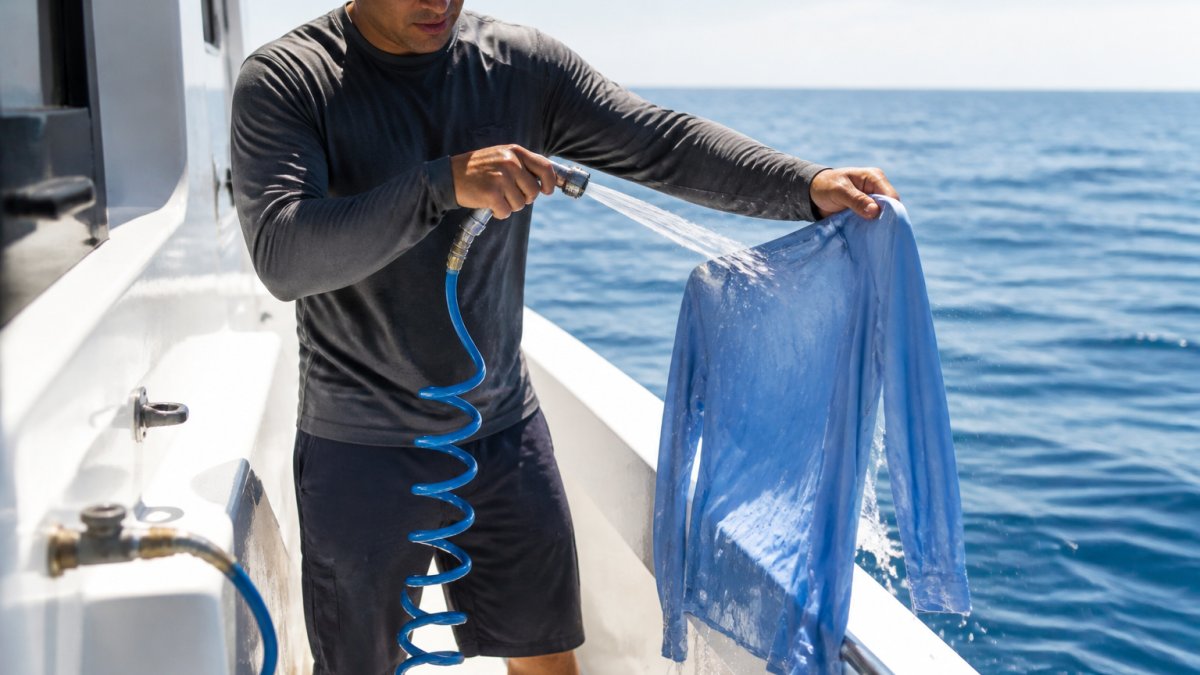
Build a Small Rinse Kit for the Boat or Bank
You don't need a full wash station, a one-gallon jug of fresh water, a microfiber towel, and a spare shirt in a dry bag cover almost every scenario. Keep the jug out of direct sun, since warm water accelerates salt bonding to synthetic fibers, and never use a raw-water washdown on apparel; it's the same saltwater you're trying to remove.
Rinse on a Schedule, Not on a Feeling
Salt spray dries fast on a hot deck, so rinse every 60 to 90 minutes during heavy spray, or immediately after a drenching wave, to interrupt evaporation before minerals concentrate. A 15- to 30-second flush handles light spray; a full soak-and-squeeze is better after a soaking.
Rinse the whole shirt, not just the wet zone. Salt migrates through seams, underarm panels, and the collar, then reappears as a ring at the edge of the dried area. Start with shoulders, chest, and sleeves, then work down.
Handle Wet Fabric Correctly
Don't wring or scrub a saltwater-soaked shirt, twisting drives salt crystals deeper into the weave and abrades performance finishes. Lay it flat, pour fresh water across it, and press gently with a clean towel; if you must wear it again before it dries, blot both sides.
If you're wading, rinse your legs and lower body before sitting on the gunwale or leaning against a cooler, salt transfers from skin and waders on contact and shows up as mystery stains later.
Keep a Spare Shirt for Long Days
On a full-day trip, a dry spare shirt is the simplest prevention tool you own. Swap when your primary shirt is soaked, bag the wet one so it doesn't dry salt into the fabric, and rinse it properly once off the water, letting a soaked shirt air-dry in the sun on the ride back is the most common way anglers create stubborn rings.
What to Skip in the Field
Fabric protectant sprays are a pre-trip step, not an in-water fix, once salt is on the shirt, a protectant traps it against the fiber. Skip detergent on the boat too: a fresh-water rinse now and a proper wash later beats a partial soap treatment that leaves residue. Save the vinegar, detergent, and stain remover for the post-trip routine, where you control water temperature and dwell time.
How to Wash Fishing Shirts After Saltwater Exposure
Your post-trip routine determines whether salt stains set or wash out easily.
Rinse Immediately with Fresh Water
The moment you're off the water, rinse your shirt. Don't leave it in a laundry bag or the truck, a fresh-water rinse within hours stops salt from bonding permanently.
Use cool or cold water, since warm water can set stains, and rinse the entire shirt, salt hides in seams and cuffs.
Hold the shirt under running water and gently squeeze to release salt crystals. Rinse for at least 15-30 seconds.
Soak and Pretreat Before Machine Washing
After rinsing, soak the shirt in cool fresh water for 30 minutes to an hour to dissolve remaining salt.
For stubborn residue, pretreat:
- Fill a basin with cool water
- Add a stain remover safe for technical fabrics
- Submerge the shirt and soak 30-60 minutes
- Gently agitate to release salt
Never use hot water for saltwater stains. Heat can set stains permanently.
Then machine wash cold with regular detergent. Avoid bleach, which damages UV-protective coatings on performance fabrics.
Best Detergent for Performance Shirts and Salt Residue
Salt residue is a mineral deposit, not a grease or protein stain, so the detergent question is what dissolves minerals without stripping the finishes that make a fishing shirt worth wearing. A detergent that works on a cotton t-shirt can quietly degrade the wicking finish, UPF treatment, or water-repellent coating on a technical shirt.
SaltyGrown Men's Short Sleeve Performance Shirt →
Match the Product to the Fabric
100% polyester. The most common fishing-shirt fabric and the most forgiving.
Nylon. More prone to odor and pilling than polyester. A mild liquid detergent plus a sport-wash every few cycles keeps it clean without over-stripping.
Polyester-spandex blends. The stretch fibers are fragile.
Cotton or cotton-blend fishing shirts. Cotton holds salt and water longer, so it needs a longer soak and a more thorough rinse.
Read the Care Label Before the Bottle
The care label is the authority, not the detergent's marketing copy. Cold wash and tumble dry low overrides any product claiming to be safe at all temperatures, and "no fabric softener" is a hard rule, softener coats fibers and blocks the wicking action you paid for.
When Vinegar Helps and When It Does Not
White vinegar is a mild acid that dissolves mineral deposits, making it genuinely useful for salt rings. A half-cup in the rinse cycle, or a 1:1 vinegar-and-water soak for set-in rings, is safe for polyester and nylon. It's not a detergent substitute, and on DWR-coated shirts frequent vinegar soaks gradually reduce water repellency. Use it for visible salt rings, not as a routine additive.
What to Avoid and Why
- Fabric softener and dryer sheets. They coat fibers, reduce wicking, and leave residue that attracts and holds salt.
- Chlorine bleach. Weakens spandex, fades dyes, and degrades UV-protective treatments.
- Oxygen bleach (color-safe bleach). Safer than chlorine on synthetics, but check the label; some UPF and DWR finishes are sensitive to it.
- Heavy-duty or grease-cutting detergents. Harsher than a technical fabric needs.
- Hot water. Heat sets salt and protein stains and stresses elastic fibers. Cold water is the default for saltwater-exposed shirts.
A Simple Decision Path
No visible rings: fragrance-free liquid detergent in cold water, air dry. White rings: pretreat with a 1:1 white vinegar and cool-water soak for 30 to 60 minutes, then wash normally. DWR finish plus regular vinegar use: switch to a sport-specific wash and consider a DWR refresh product. If the care label forbids a product, don't use it.
How to Remove Salt Stains from Clothes Once Set In
If salt stains are already visible, don't panic. Set-in stains require more aggressive treatment, but they're usually removable.
White Vinegar Solution for Salt Rings
White vinegar dissolves mineral deposits water alone can't shift. Mix equal parts white vinegar and cool water in a basin.
Submerge the stained area and soak 30-60 minutes. The vinegar breaks down salt crystals without damaging synthetics.
After soaking, rub gently with a soft cloth or sponge, gentle pressure works better than scrubbing. Rinse thoroughly to remove the vinegar smell.
Machine wash cold after the vinegar treatment. Vinegar pretreatment plus standard washing removes most set-in salt stains.
Stain Remover Products Safe for Technical Fabrics
Commercial stain removers made for sports and technical clothing work well on salt stains. Choose color-safe products safe for polyester.
Apply directly to the salt ring, let sit 5-10 minutes, blot with a clean cloth, rinse cool, and machine wash.
Test any new product on a hidden area first. Some removers can bleach or damage certain dyes.
Avoid chlorine-based cleaners; they weaken synthetic fibers and cause fading.
How to Remove Fish Blood Stains from Shirts
Fish blood stains differently than salt: its protein bonds to fabric and requires a different approach.
Rinse immediately with cool water, hot water sets protein stains permanently. Blot with a clean cloth as you rinse.
Cool water alone often removes fresh blood.
Never use warm or hot water on blood stains, heat bonds protein tightly to fibers.
After soaking, gently rub the stain with your fingers or a soft cloth, then machine wash cold.
Drying Your Fishing Shirt to Prevent Salt Rings
How you dry your shirt matters as much as how you wash it.
Never use direct heat like a clothes dryer. High heat sets salt stains permanently and damages moisture-wicking coatings.
Don't hang the shirt in direct sun while still wet with saltwater, as it evaporates, salt concentrates into visible rings.
Reshape the shirt while damp to prevent wrinkles, which trap moisture and hold salt residue.
Salt stains on fishing shirts are preventable with the right approach.
Frequently Asked Questions
How soon should you rinse a fishing shirt after saltwater exposure?
Rinse your fishing shirt with fresh water as soon as you leave the water, ideally within 15-30 minutes. The longer salt residue sits on the fabric, the deeper it penetrates the fibers and the harder it is to remove. If you're on a boat, rinse immediately with a freshwater hose or bucket. When you get home, soak the shirt in cool fresh water for 15-30 minutes before washing. Quick rinsing prevents salt stains from setting permanently.
Can you use vinegar to remove salt stains from clothes?
White vinegar can be used for removing salt stains. Test any solution on a hidden area first to ensure it won't affect the shirt's color or print.
What fabric should you choose to resist salt stains better?
Technical fabrics like 100% polyester with moisture-wicking properties resist salt stains better than cotton. Polyester is naturally snag, stain, and odor resistant, making it ideal for fishing shirts. The SaltyGrown Men's Short Sleeve Performance Shirt, made from lightweight 4 oz. polyester with UPF 44+ protection, is engineered to resist stains while keeping you cool on the water.
Should you air-dry or machine-dry a saltwater fishing shirt?
Air-dry your fishing shirt in a shaded area or indoors. Avoid direct heat and sunlight, which can set salt stains permanently and fade fabric color. Hang the shirt on a clothesline or lay it flat. Direct heat from a dryer can also damage the moisture-wicking properties and UV protection of performance fabrics. If you must use a machine dryer, use the lowest heat setting and remove the shirt while slightly damp to prevent salt rings from forming during the drying process.