
7 Durable Saltwater Resistant Fishing Shirts for 2026
Table of Contents
- Quick Comparison: Durable Saltwater Resistant Fishing Shirts
- What Makes a Fishing Shirt Saltwater Resistant
- UPF 50+ Fishing Shirts: Sun Protection That Lasts
- Short Sleeve vs. Long Sleeve: Which Performs Better in Salt
- Moisture-Wicking Fishing Apparel: Staying Dry All Day
- Saltwater Fishing Gear Maintenance: Extend Your Shirt's Life
- How to Choose the Right Shirt for Your Fishing Style
- Frequently Asked Questions
Last Updated: September 27, 2026
Quick Comparison: Durable Saltwater Resistant Fishing Shirts
A durable saltwater resistant fishing shirt must handle UV rays, salt spray, sweat, sunscreen, and fish slime without degrading, fading, or losing protective qualities during 10+ hour days on the water.
The right shirt keeps you cool and dry while resisting stains, abrasion, and degradation through multiple seasons of hard use.
| Shirt | Price | UPF Rating | Key Strength | Best For |
|---|---|---|---|---|
| SaltyGrown Men's Long Sleeve Performance | $35 | UPF 44+ | Moisture-wicking polyester, reinforced seams | All-day comfort on flats and offshore |
| SaltyGrown Men's Short Sleeve Performance | $30 | UPF 44+ | Lightweight, fade-resistant prints | Hot weather and midday fishing |
| SaltyGrown Men's Tarpon Long Sleeve | $35 | UPF 44+ | Species-specific design, bold graphics | Dedicated tarpon anglers |
| SaltyGrown Men's Redfish Long Sleeve | $35 | UPF 44+ | Backwater-ready construction | Flats fishing in shallow water |
| SaltyGrown Men's Snook Long Sleeve | $35 | UPF 44+ | Mangrove-tested durability | Inshore edge fishing |
| SaltyGrown Men's Mahi Long Sleeve | $35 | UPF 44+ | Offshore-rated performance | Offshore and open water |
| SaltyGrown Men's Florida Lobster Long Sleeve | $35 | UPF 44+ | Dive-and-fish versatility | Divers and multi-purpose anglers |
What Makes a Fishing Shirt Saltwater Resistant
Saltwater resistant fishing shirts use 100% polyester, which resists salt corrosion and staining better than natural fibers because it doesn't absorb saltwater.

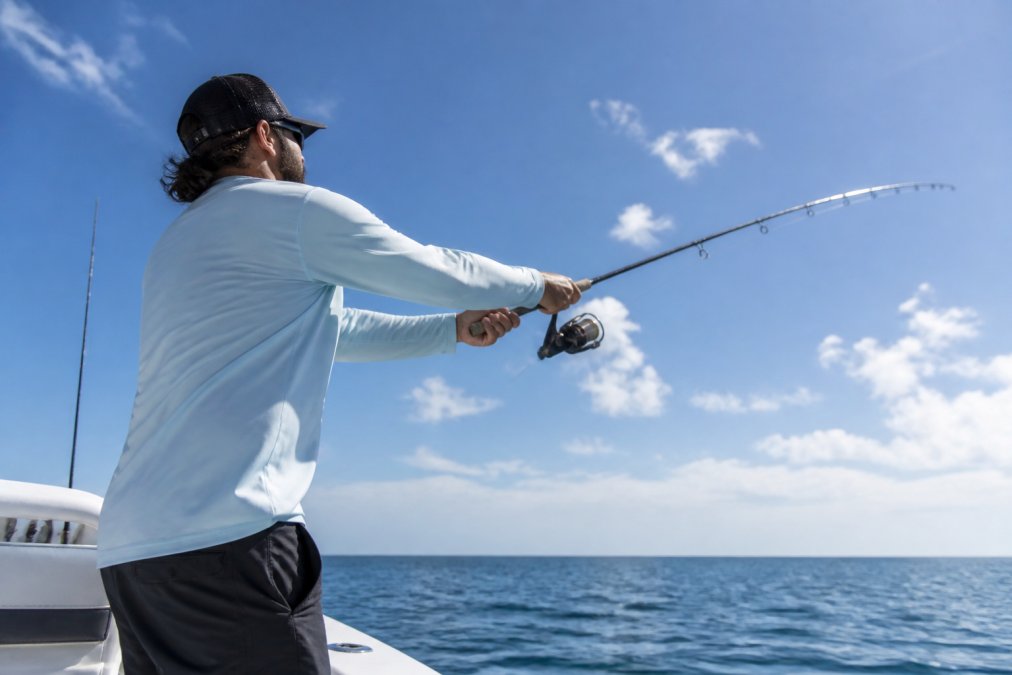
How Salt Actually Degrades Fabric
Salt degrades fabric through two mechanisms: salt crystals absorb moisture and weaken fibers, and they abrade fibers microscopically with each movement. A shirt worn in salt spray for 40 hours can show the same degradation as a freshwater shirt worn for 200 hours.
Polyester resists salt degradation because its smooth surface prevents salt crystals from embedding and abrading fibers. Rinsing works effectively with polyester because salt doesn't set permanently into the fiber.
Fabric Weight and Density Matter More Than Most Realize
Mid-weight polyester (160-180 gsm) with tight knit construction provides optimal salt resistance. Tight knits block salt crystals from reaching the fiber core, while loose knits allow deeper penetration and faster degradation.
SaltyGrown's mid-weight polyester with tight knit construction maintains color and structural integrity through multiple seasons.
Anti-Microbial Treatment and Stain Resistance
Anti-microbial treatments prevent sunscreen and fish oils from oxidizing in fibers, keeping shirts functional and visually acceptable through dozens of washes.
Construction Quality Determines Longevity
Reinforced shoulder seams, double-needle stitching, and flat-lock seams prevent unraveling and salt accumulation, separating gear that lasts two seasons from gear that lasts five.
UPF 50+ Fishing Shirts: Sun Protection That Lasts
SaltyGrown's performance shirts deliver UPF 44+ sun protection (blocking 98% of UV rays) across the entire line. UPF ratings are built into the fabric structure through tight knit construction, not applied as a coating, so protection lasts through dozens of washes.
Short Sleeve vs. Long Sleeve: Which Performs Better in Salt
Sleeve choice depends on your fishing environment: offshore and inshore fishing create different conditions requiring different strategies.
Offshore Fishing: Wind, Speed, and Salt Spray
Offshore fishing demands long sleeves during transit for wind protection (high-speed runs create 15-20 degree wind chill) and to shield skin from intense salt spray. The shirt absorbs salt exposure, protecting your skin.
For active offshore fishing, short sleeves dry faster and offer less restriction. Strategy: wear long sleeves during transit, then switch to short sleeves once fishing begins.
Inshore and Flats Fishing: Sun Angle, Humidity, and Extended Exposure
Inshore fishing, flats, backwater, mangrove, and marsh environments, creates opposite conditions. Boat speeds are slower, wind is less intense, but sun exposure is relentless and often amplified by water reflection. Early morning light and long afternoon sessions mean 8-12 hours of direct or reflected sun exposure. The sun angle is lower and more directional, meaning your arms and shoulders receive sustained UV exposure that peaks in mid-morning and mid-afternoon.
Humidity is also dramatically higher in inshore environments. Shallow water, mangrove coverage, and stagnant air create conditions where moisture doesn't evaporate as efficiently. A moisture-wicking shirt becomes essential because the air can't absorb sweat the way it does in open water. A shirt that wicks moisture away from your skin prevents the clammy, heavy feeling that develops after 6+ hours in humid conditions.
SaltyGrown Men's Long Sleeve →
Long-sleeve shirts are the standard for serious inshore anglers. Full-arm coverage extends your protected time in the sun by hours. For early morning sessions starting at first light, long sleeves keep your arms shielded during the hours when UV intensity is highest relative to sun angle. The SaltyGrown Men's Redfish Long Sleeve and SaltyGrown Men's Snook Long Sleeve are purpose-built for backwater environments where sun reflects off shallow water and mangrove edges amplify heat.

The inshore strategy: Wear long sleeves for the entire session. The extended sun exposure and reflected UV from shallow water make full-arm protection essential. Moisture-wicking performance becomes your cooling mechanism in humid conditions where air circulation is limited.
Durability Differences Between Sleeve Lengths
Durability is similar between sleeve lengths. Long sleeves offer one advantage: they reduce direct salt spray exposure to skin, minimizing salt-induced irritation during multi-day trips.
Building a Rotation for Year-Round Fishing
Serious anglers use both: short sleeves for midday and offshore active fishing, long sleeves for dawn/dusk and all-day inshore sessions. Commercial fishermen use long sleeves for 10-12 hour workdays requiring full-arm protection.
Moisture-Wicking Fishing Apparel: Staying Dry All Day
Moisture-wicking actively transports sweat to the outer surface for evaporation, keeping you cooler than cotton, which absorbs and holds moisture. SaltyGrown's 100% polyester shirts stay light and dry from first light to last cast, preventing the clammy, heavy feeling that develops after hours on the water.
Saltwater Fishing Gear Maintenance: Extend Your Shirt's Life
Saltwater corrosion happens fast if you don't rinse immediately. Salt crystals embed themselves into fabric fibers, accelerating degradation and fading. The single most important maintenance step is rinsing with fresh water within an hour of saltwater exposure.
Wash in cold water with mild detergent. Hot water can set stains and damage the tight knit construction that provides UV protection. Avoid bleach and fabric softeners, they break down synthetic fibers and reduce moisture-wicking performance.
Air dry whenever possible. Machine drying generates heat that can damage the ultra-tight knit and fade bold prints. Hang your shirt in shade with good airflow. This takes longer but preserves the shirt's structural integrity and color vibrancy for years.
Store in a cool, dry place away from direct sunlight when not in use. UV exposure during storage degrades the fabric just as it does on your body. A dark closet is ideal. Avoid plastic bags, which trap moisture and promote mildew growth in humid coastal climates.
Inspect seams and print quality regularly. Reinforced shoulder seams are durable, but catching damage early prevents unraveling. If a seam starts to separate, repair it immediately with heavy-duty thread. A small fix now prevents catastrophic failure later.
Many anglers report that their SaltyGrown shirts maintain color and structural integrity through five or more seasons of regular use. This longevity comes from the performance fabric, tight knit construction, and proper maintenance.
How to Choose the Right Shirt for Your Fishing Style
Your fishing environment determines which features matter most. Offshore anglers prioritize durability in harsh conditions and moisture-wicking for active work. Flats anglers prioritize full-arm UPF protection and lightweight construction. Commercial fishermen prioritize rugged seams and stain resistance for 12-hour workdays.
Frequently Asked Questions
What features make a fishing shirt saltwater resistant?
Saltwater resistant fishing shirts combine synthetic performance fabrics, reinforced seams, and stain-resistant treatments. The best designs use 100% polyester with tight knit construction to prevent salt crystals from embedding in fibers. Look for shirts with snag resistance, odor resistance, and fade-resistant dyes. Reinforced shoulder seams handle the repetitive stress of casting, while tag-free necks eliminate chafing during long days on the water.
Why is UPF protection important in saltwater fishing shirts?
UPF 44+ protection blocks harmful UV rays that intensify over water due to reflection off the surface. Saltwater environments amplify sun exposure, increasing skin damage risk during extended fishing trips. UV-blocking fabrics built into performance shirts allow you to stay on the water longer without sunburn. This matters for both recreational anglers and commercial fishermen working 8-12 hour days in direct sun.
How do you care for saltwater fishing shirts to maintain durability?
Rinse your shirt with fresh water immediately after saltwater exposure to remove salt crystals that degrade fabric over time. Wash in cold water with mild detergent, avoiding bleach and fabric softeners that break down performance fibers. Air dry when possible to preserve elastic properties. For stubborn stains from sunscreen or fish slime, pre-soak in cold water before washing. Proper care extends shirt life from one season to multiple years.
Are synthetic fishing shirts better than cotton for saltwater conditions?
Yes. Synthetic performance fabrics like 100% polyester outperform cotton in saltwater environments. Cotton absorbs salt water and retains moisture, promoting mildew and odor while losing shape. Polyester wicks moisture away, resists salt degradation, and maintains its form through repeated washing. Synthetic fibers also dry faster, reducing the window for salt crystallization and fabric damage.